Commercial EV charging operating costs: build a budget
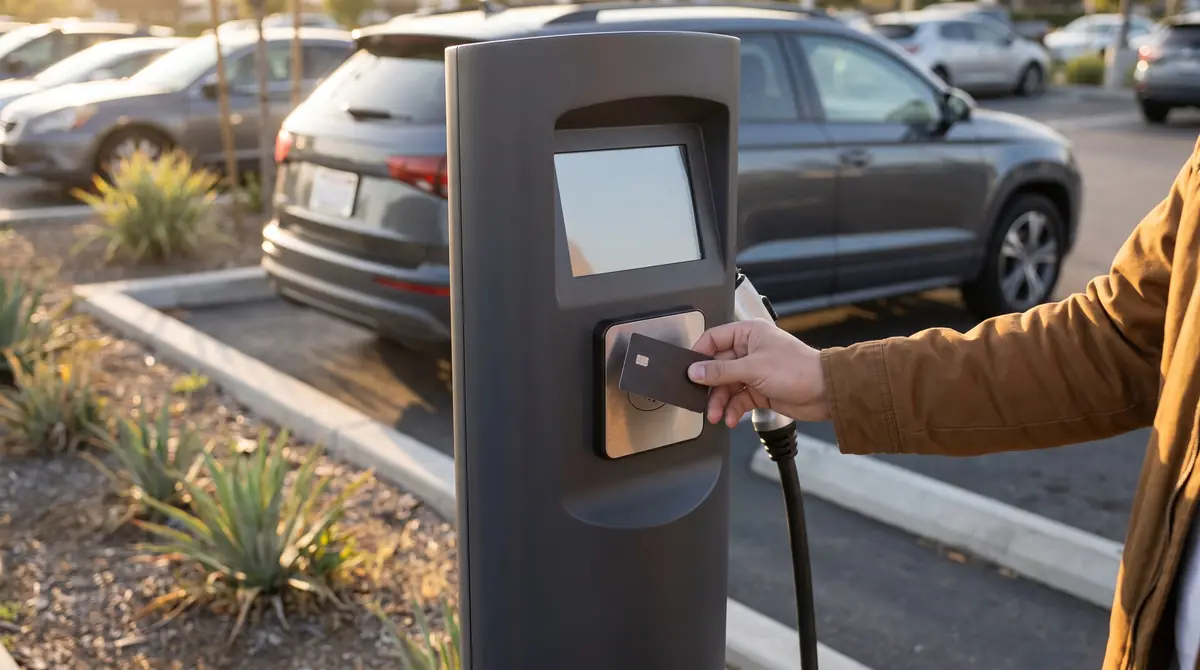
Use the actual electricity tariff, expected use, network/payment fees, maintenance and administration to build an operating budget. Installation is separate. A per-kWh energy figure may not be the whole bill.
Want this done at your property? Get an installer, or ask a question.
Build the recurring-cost budget
| Cost | Input to obtain |
|---|---|
| Energy | Wall-side kWh by time period, tariff rates, taxes and adjustments |
| Demand/fixed charges | Applicable rate, billing interval, facility demand, minimums and ratchet rules |
| Network/software | Per-port/site fees, connectivity, reporting, renewal and escalation |
| Payments | Percentage/fixed fees, refunds and settlement |
| Maintenance | Inspection, repairs, parts, warranty gaps and service contract |
| Administration | Support, billing disputes, parking rules, training and accounts |
DOE identifies electricity, maintenance and applicable network fees as recurring costs.1 Get current terms for your proposed system rather than assigning one annual national figure to every site.
kWh and kW answer different questions
kWh measures energy over time; kW measures power. Under a demand tariff, charging alongside other building loads can affect the bill. SCE's business EV page distinguishes its existing single-meter rate from dedicated-meter EV rates.2 These options apply in SCE territory, not nationally.
Ask your utility which rate applies, whether separate metering is useful, how demand is measured and how growth changes the rate. Ask the installer/provider whether scheduling or controls meet vehicle needs within those conditions. Do not assume all AC projects avoid demand charges or all EV rates remove them.
Illustrative monthly energy calculation
Suppose charging records 2,000 wall-side kWh in a month. At an assumed $0.15/kWh, the energy component is $300; at $0.25/kWh, it is $500. These prices are examples, not tariff quotes. Neither result includes demand, fixed charges, taxes, software, processing or maintenance. Battery-side energy would require a loss assumption.
Name the bill and service owner
Record who pays the utility, sets driver prices, receives network invoices, authorizes repairs and handles faults. Third-party equipment ownership does not establish responsibility for electricity or every repair; read the contract. See ownership and service models.
Review actual use
Compare billed energy, peak demand, sessions, faults and fees with planning assumptions. A low tariff is not useful if vehicles cannot finish before departure. Keep financial performance and charging readiness as separate measures.
Decide access and billing, then include operating questions in your request.
Sources and check dates
- Operation and Maintenance for EV Charging Infrastructure, U.S. Department of Energy, AFDC. Read 2026-10-13.
- Electric Vehicle Energy Rates, Southern California Edison. Read 2026-10-13.
Related guides

EV charger access, payments and billing
Decide who can charge and who pays before choosing hardware or network. Different users need different access and billing arrangements. A charging-session report is not automatically an approved utility billing meter.
Read it
EV charging ownership and service models
Compare equipment and wiring ownership, recurring costs and operating control. Purchase, managed services and third-party hosting allocate these differently. The actual contract matters more than the model’s label.
Read it
Fleet depot charging plan: energy, dwell and readiness
Start with the energy each vehicle needs before departure and its usable charging window. Assess equipment, power allocation and utility service together. Fleet size alone does not determine charger count or service capacity.
Read itWant a charger installed at your property?
Send your property type and ZIP code, and a licensed installer for your area gets in touch.